Tanya L. Young
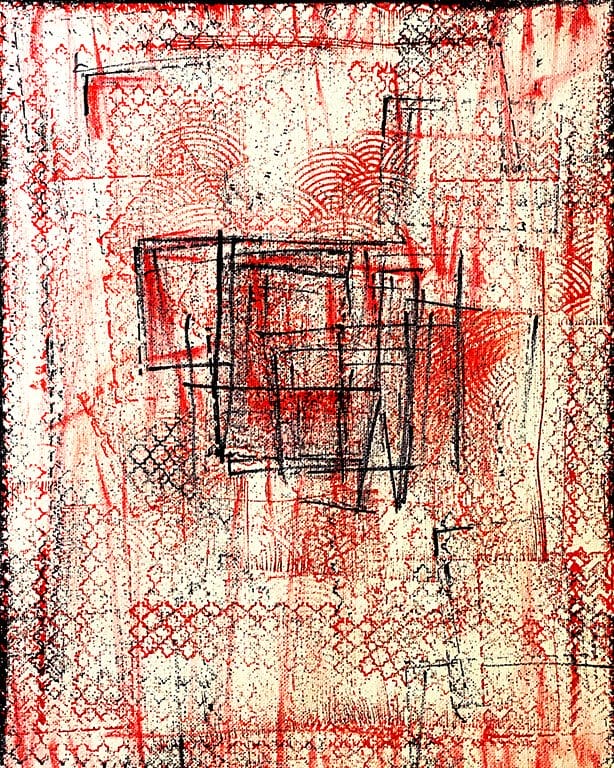
Ravenous
Tanya L. Young is a Washington based artist and writer. Her work has been featured in New York Quarterly, Jeopardy Magazine and Stonecoast Review.

Ravenous
Tanya L. Young is a Washington based artist and writer. Her work has been featured in New York Quarterly, Jeopardy Magazine and Stonecoast Review.
Just ten years ago, I felt young,
before that, not old enough.
Before now, geologists say,
there was a before, a before before
when ice, white cedar trees, and dark
brown salt deposits lined the coast.
When the waves pound the shore,
I hear the churning, churning
of saltwater like the buckled inner-
workings of the mind.
The surging of desires that wash
ashore, recede, and reemerge
like a hand extending
and then retracting itself mid-air.
On the boardwalk, a couple shares
a scone. Ahead, a child carves
a moat around a sandcastle. Above,
the seagulls seem lost—
they throw their bodies into the air
any which way, skim the water’s
surface, then take flight, as if to say:
Never mind or not today. I close
my eyes: salt turns to sugar in my mouth.
The January sun stings
my eyelids amber. Beneath this layer
is another layer: of cedar, peat,
marsh. Two teenagers giggle
with lattes. One young, the other
even younger. How many mornings,
like this one, have I already forgotten?
A Labrador chases a tennis ball
into the water and flashes its teeth.
I grin back. Day, too, froths at the mouth.
Shannon K. Winston’s poems have appeared in Crab Creek Review, The Night Heron Barks, RHINO, Rust + Moth, and elsewhere. Her work has been nominated for a Pushcart Prize and several times for the Best of the Net. Her poetry collection, The Girl Who Talked to Paintings, was published by Glass Lyre Press in 2021. She currently lives in Princeton, New Jersey. Find her at shannonkwinston.com.
The pawnshop faced the traffic of Putnam Avenue. The people who went inside usually ducked their heads and moved with quick movements, but my dad liked to go in and wander around and buy things like old VCRs and televisions and dishwashers – a purchase he would forever regret after our house became infested with roaches. But Dad’s biggest regret came not from purchasing from the pawnshop but from selling his most prized possession to it.
I don’t know what lawsuit or worker’s compensation claim landed my dad with the money to buy that Gibson Les Paul. What I do remember is him giving each of us kids $100 when the windfall came down. I held the money in my hand, vowing to save it, but over the course of a week bought $100 worth of pickles instead because those Big Papa pickles were the shit.
He had guitars before but none as beautiful as that dark green Gibson. I watched him open its case and run his hands over the red velvet interior before picking it up and stroking its strings. One thrum and a dreamy sort of faraway look passed over his face.
Dad loved that guitar but pawned it on the regular because on the regular, we were broke. He always managed to round up the cash to get it out of pawn before they kept it. Then one time, he didn’t, and when we drove by the pawnshop, his Gibson was sitting in the window with a for sale sign slung around its neck. One day we drove by again, and the Gibson was gone.
Each time Dad drove by the pawnshop, he cringed a little until eventually, he wouldn’t look at its windows at all.
April Sharp is an English instructor at Felbry College School of Nursing, and a graduate of the Northeast Ohio Master of Fine Arts program. She often writes of her childhood growing up in Southeast Ohio. Her work has been featured in The Devil Strip, Rubber Top Review, and Appalachia Bare. When not writing she can be spotted stomping through the woods with her two dogs.

Black Sand Beach
Jim Ross jumped into creative pursuits in 2015 after a rewarding career in public health research. With a graduate degree from Howard University, in six years he’s published nonfiction, poetry, and photography in over 150 journals and anthologies on four continents. Publications include 580 Split, Bombay Gin, Burningword, Columbia Journal, Hippocampus, Ilanot Review, Journal of Compressed Creative Arts, Lunch Ticket, The Atlantic, The Manchester Review, and Typehouse. Recent photo essays include Barren, Kestrel, Litro, New World Writing, So It Goes, and Wordpeace. A nonfiction piece led to a role in the documentary limited series, “I, Sniper.” Jim and his wife—parents of two health professionals and grandparents of five preschoolers—split their time between city and mountains.
Plug Nickel and Red Cent
met on museum steps and, inside,
mysticked with blue innocent Della Robbia,
rhythmed the light-shine white
of beyond, above, bright,
orisoned warm-milk fired clay, like flesh,
god-child in supple mother embrace.
Sigh of centuries.
Out straight west, they drove
their wood-paneled station wagon,
out past the 30-hundreds, the 40-hundreds,
nearly to the 52-hundreds
on the table-top Chicago grid,
out to Leamington to meet the gray-pants boy,
sitting on front porch steps, in full view — a
white-red-striped t-shirt buzz-cut good-boy,
out from inside, away, at large,
watching ant-gang heft cornbread crumbles
except this one alone, down sidewalk square
to an insect Promised Land.
He looked up at the two men,
vaguely priestly, vaguely outlawed,
said: “I’m looking to flee captivity
for the sin I don’t recall committing.”
“We’re guilty, too,” they said, and
the three walked to afternoon church,
for Stations of the Cross,
flaming altar candles, up, reaching always up,
echoes, shuffling, Latin abracadabras,
plainsong up, incense up from censor,
from burning coal, straining up,
cloud of unknowing, cloud of Mount Sinai,
cloud of breathing and not breathing.
After Amen, the three split up
and went home by a different path.
Patrick T. Reardon, a three-time Pushcart Prize nominee, is the author of ten books, including the poetry collections Darkness on the Face of the Deep (Kelsay) and Requiem for David (Silver Birch Press) as well as Faith Stripped to Its Essence, a literary-religious analysis of Shusaku Endo’s novel Silence. His poetry has appeared in America, Rhino, Main Street Rag, The Write Launch, Meat for Tea, Under a Warm Green Linden and many others. His book Puddin: The Autobiography of a Baby, a Memoir in Prose-poems is forthcoming from Third World Press.