Dr. Benjamin Erlandson is the founder of an ecological educational nonprofit fostering bioregionalism, ecological literacy, and stewardship across the biosphere, an outsider scholar following dynamic inquiry to defy disciplines, practicing systems wisdom. Trained in narrative, photography, filmmaking, and new media production at UNC-Asheville (BA) and Emerson College (MA), he captures multimodal narrative traces in defiance of anthropocentrism and human exceptionalism. He was an NSF IGERT Fellow in Arts, Media, and Engineering at Arizona State University. Recent juried exhibitions of his work include Spanish Peaks Arts Council, Photocentric Gallery, R Gallery, Valdosta State University, Spiva Center for the Arts, Hilliard Gallery, San Fernando Valley Arts & Cultural Center, Yeiser Art Center, Wilson Arts Center, Turchin Center, and Roger Tory Peterson Institute. In 2025, he was a multidisciplinary artist-scholar in residence at Pine Meadow Ranch in Sisters, Oregon. He is a volunteer photographer for the National Park Service on the Blue Ridge Parkway.
The cat will sit on my desk and help me write stories about love. About loss. About a cat who will claw up the furniture, but I won’t give a damn because she will make biscuits on my poofy belly and never suggest I work on strengthening my core. I know her, this orange kitten, the one I dream about. I belong to her as she belongs to me. It feels like love, but the kitten isn’t real. It’s been a few months since our old dog, Sugar, died. The kitten will purr away the ringing in my ears. The kitten will love me back.
The vet said Sugar crossed the Rainbow Bridge. Do humans cross there too? Do we remain who we were, with the same endearing traits? The same annoying habits? Become stardust? Do we know we’re dead? Wish we weren’t? Glad we are?
It’s 25 years since my daughter died. Will she see the kitten and be glad for me? Will the kitten know we’re being watched as we make our biscuits?
The kitten isn’t real. But how can I live without a kitten? How can I live without my daughter? Nine lives wouldn’t have been enough. Clawed up furniture won’t kill me or even make me cry.
Here kitty. Come, let’s make some biscuits. Let’s dig our claws into the soft nubby wool of the sofa. Shred it. Now try the linen on this chair. See how good it feels. Rip it. Bite it. Flex your little claws and grab another thread. Here, I’ll help you. Watch it all unravel.
We’ll grow old together. Cover the sofa with blankets. Haul the chair to the curb. What will any of that matter? Where will you go, I wonder, when you leave this earth. Fur heaven? Chasing lasers across the galaxy? Will you remember me? Will you make biscuits for another grieving mother or a sad child, a lonely dog longing for a companion? A dog who will love the feel of your tiny claws raking his fur? You don’t want to be an indoor cat. You have always been free. Claw the furniture, darling, but you must leave the birds alone.
My daughter wanted to be free. Of rules and curfews. Of her own relentless expectations. Of me. I dreamed that she was alive. I lifted the veil and found her living nearby. All those years in the same town. I begged her to come home. She refused and closed the door.
We used to bake bread together. Six braid challahs with an egg wash. Always a piece separated. Tossed into the back of the oven, a nod to tradition not our own. An offering to sanctify the bread. How do I sanctify her?
What will I offer the kitten? A screened porch from which to watch the birds. Will she love me back? Or want to be free. Of rules and curfews. Of relentless expectations. Of me.
Eileen Vorbach Collins
Eileen Vorbach Collins writes true stories she wishes were fiction and fairy tales she wishes were true. Her essays have received the Diana Woods Memorial Award for Creative Nonfiction, The Gabriele Rico Challenge Award, a Glenna Luschei Prairie Schooner Award, and two Pushcart Prize nominations. Her essay collection, Love in the Archives, a Patchwork of True Stories About Suicide Loss, published in 2023, was a Foreword Indies Finalist and received a Pencraft Award for Literary Excellence and the Sarton Women’s Book Award for memoir.
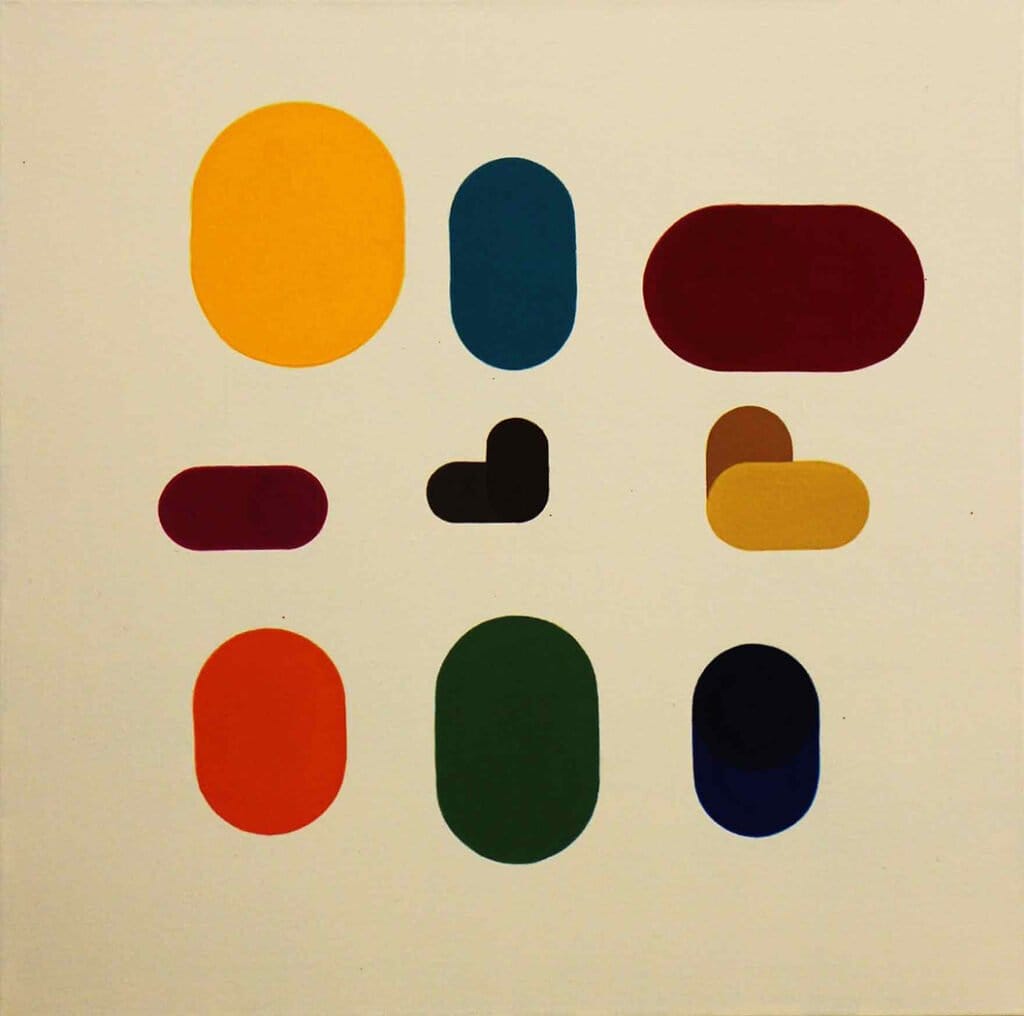
Jean Wolff has had group and solo exhibits in various galleries in New York City and internationally. In addition, she has published 154 works in 105 issues of 61 magazines. Born in Detroit, Michigan, she studied fine arts at the Center for Creative Studies in Detroit and at the University of Michigan in Ann Arbor, receiving a BFA in studio arts. She then attended Hunter College, CUNY in New York, graduating with an MFA in painting and printmaking. She is now part of the artistic community of Westbeth in Manhattan.
Our mothers die quickly. When we grieve, time rushes out of us like old light. They lowered the body into the black end of the ground. All the worms turned, delighted. The sun threw itself on the dirt like a lover returning. I couldn’t help but sink after her. I went in like a delirious fly. My body thunked with the weight of all its years. I was made of gold. They didn’t pull me out; a mutual understanding flossed between their silence. One hand after the other tossed the tender earth over us, the dirt a showering of black stars. I curled my head on my mother’s dead shoulder and pressed against her like a newborn shadow. A year later, I emerged from that grave, a thousand sheets of air driving though me. I could feel her moving beneath my feet like a barge on the river. But I adored the sight, the sun with its throat on display, yellow on either end of this terrible world.
Rome Smaoui
Rome Smaoui is a Tunisian poet and writer born in 2003. Her work has appeared in Narrative Magazine, SMOKE Magazine, Litbreak Magazine, Rejected Literature, and other places. She has recently received her Bachelor’s in English Literature with Creative Writing from the University of Manchester. Upon graduating, she was awarded the 2024 George Gissing Memorial Prize for her Fiction and the 2024 Alun Lewis Prize for her Poetry.
Featuring:
Issue 119, published October 2026, features works of poetry, flash fiction, short nonfiction, and visual art by Linda K Allison, Gilbert Arzola, Sarah Barbo, Roger Camp, Barbara Daniels, Natalia Danjon, Virginia Doré, Chris Dungey, FruitAndNut, Tom Gdisis, Cleo Griffith, Lesley Hart Gunn, Mark Hendrickson, Zebulon Huset, Romana Iorga, Ryo Kajitani, Carella Keil, Merie Kirby, Grace Lynn, Daniel Moon, Sylvie Oleta, Josh Price, Stacy Rollins, Elizabeth Rosen, David J. Schast, Judith Shapiro, VA Smith, Stefan Sofiski, Lisa Christina St John, Valy Steverlynck, Kathryn Temple, John Walser, Megan Wildhood, Stephen Curtis Wilson, S.E. Wilson, Roberta Winters, Jean Wolff, Jason Youngclaus, Matt Zambito, and Esther Zhang.
64 Pages, 6 x 9 in / 152 x 229 mm, Premium Color, 80# White — Coated, Perfect Bound, Glossy Cover
To provide the best experiences, we use technologies like cookies to store and/or access device information. Consenting to these technologies will allow us to process data such as browsing behavior or unique IDs on this site. Not consenting or withdrawing consent may adversely affect certain features and functions (bookstore, announcements, submissions, etc).
Functional
Always active
The technical storage or access is strictly necessary for the legitimate purpose of enabling the use of a specific service explicitly requested by the subscriber or user, or for the sole purpose of carrying out the transmission of a communication over an electronic communications network.
Preferences
The technical storage or access is necessary for the legitimate purpose of storing preferences that are not requested by the subscriber or user.
Statistics
The technical storage or access that is used exclusively for statistical purposes.The technical storage or access that is used exclusively for anonymous statistical purposes. Without a subpoena, voluntary compliance on the part of your Internet Service Provider, or additional records from a third party, information stored or retrieved for this purpose alone cannot usually be used to identify you.
Marketing
The technical storage or access is required to send newsletters, calls for submissions, and for similar publishing purposes.
To provide the best experiences, we use technologies like cookies to store and/or access device information. Consenting to these technologies will allow us to process data such as browsing behavior or unique IDs on this site. Not consenting or withdrawing consent, may adversely affect certain features and functions.
Functional
Always active
The technical storage or access is strictly necessary for the legitimate purpose of enabling the use of a specific service explicitly requested by the subscriber or user, or for the sole purpose of carrying out the transmission of a communication over an electronic communications network.
Preferences
The technical storage or access is necessary for the legitimate purpose of storing preferences that are not requested by the subscriber or user.
Statistics
The technical storage or access that is used exclusively for statistical purposes.The technical storage or access that is used exclusively for anonymous statistical purposes. Without a subpoena, voluntary compliance on the part of your Internet Service Provider, or additional records from a third party, information stored or retrieved for this purpose alone cannot usually be used to identify you.
Marketing
The technical storage or access is required to send newsletters, calls for submissions, and for similar publishing purposes.