Kathryn Jordan
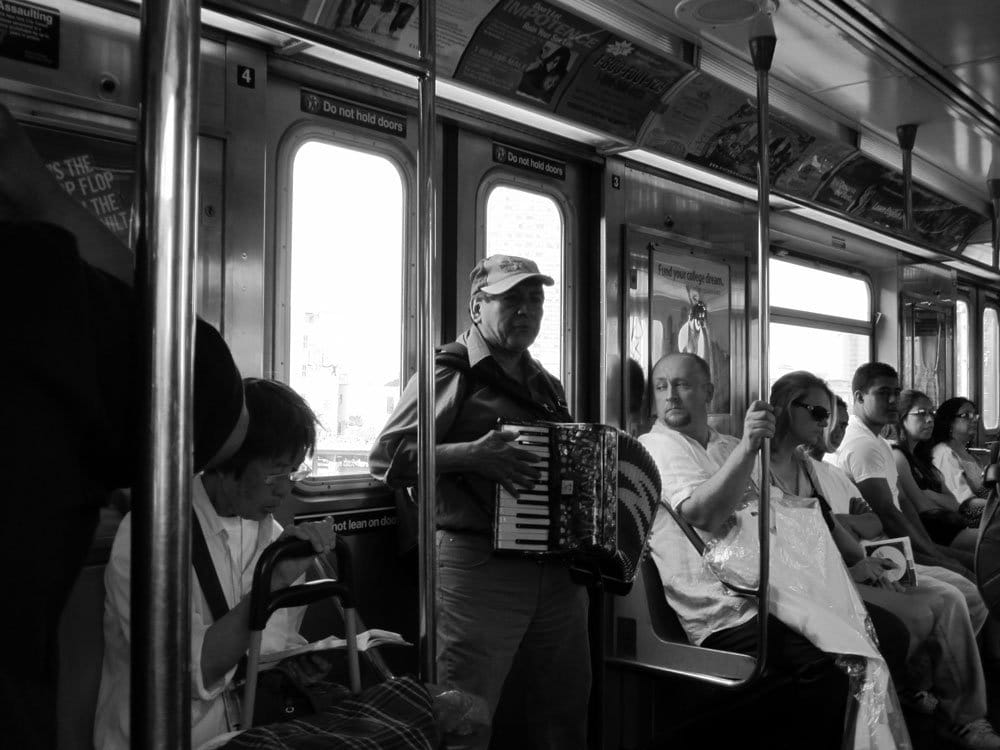
Man and accordion
Kathryn Jordan
Award-winning poet Kathryn Jordan loves to take pictures when she’s not sure she can find the words. http://kathrynjordan.org

Man and accordion
Kathryn Jordan
Award-winning poet Kathryn Jordan loves to take pictures when she’s not sure she can find the words. http://kathrynjordan.org
No to the limoncello, liquid sunshine in hand-painted glass bottles.
No to the porcelain-handled pizza cutters poised to slice a pie.
Nope to the floral-print tablecloth/napkin sets, nope to Deruta pottery blue-rimmed with lemons.
No to the prayer candles, neither Madonna and Child nor Madonna Ciccone.
No to the mother-of-pearl music boxes tinkling That’s Amore.
No to a Sexy Priests 12-month calendar— but Father August is devilishly hot!
Nope to Quentin Tarantino prayer candles— enough already.
No to Mount Vesuvius snow globes, though the ashes are quite fitting.
But to the wicker baskets brimming with little clay heads— I say Yes!
and pay three euros for the one that looks like yours.
The Muffin Man woke at 4 a.m., turned on
the lights at Drury Lane. He gathered ingredients: lemons,
flour, eggs, sugar, poppy seeds, baking powder, milk, butter, salt.
It was Tuesday, a lemon-poppy seed bake.
Everyone knew The Muffin Man. Or thought they did.
In the solitude of pre-dawn, he was not above smoking a cigarette
while he stirred, flicking an ash or two into the batter.
And it wasn’t even Ash Wednesday. People didn’t know him,
only that Thursday was cherry chocolate, Friday was blueberry crumble.
Muffins weren’t the only thing crumbling.
For years now, The Muffin Man dreamed of a different life—
one where he braised osso buco at a seaside café.
Where he worked side by side with a soulmate wife
while the kids played underfoot, and his friends— those guys
he should have stayed tight with since high school—
came around on Saturday nights for a plate of oysters
and a bottle of pinot gris. Things hadn’t turned out the way he’d hoped.
He took another drag on the cigarette, greased the muffin tins.
“After the morning rush,” he said aloud to no one but himself,
“I’m going to post my profile on one of those dating sites— Binge,
or Yes, Chef, or maybe FreshCatch.com.” But The Muffin Man knew
he was all flour dust, no yeast.
He’d spend another afternoon in the safe embrace
of Zillow: commercial zone, large oven, ocean view.
Ann Weil
Ann Weil is the author of Lifecycle of a Beautiful Woman (Yellow Arrow Publishing, 2023) and Blue Dog Road Trip (Gnashing Teeth Publishing, October 2024). Her poetry appears or is forthcoming in Pedestal Magazine, RHINO, Chestnut Review, DMQ Review, Maudlin House, 3Elements Review, and elsewhere. Her poem, “Moon Child,” was nominated for a Pushcart Prize by Burningword Literary Journal and selected for inclusion in the 2024 Edition of Best New Poets. She earned her doctorate at the University of Michigan and lives with her husband and soul-dog in Ann Arbor, MI, and Key West, FL.
my mother dreams of taking off
in a hot air balloon, not exactly flying
but rising, a slow-motion escape
fueled by the hiss of flame
parachute silk and her breath-
held longing to be lifted
from ground
she collects postcards and prints
of antique airships and dirigibles
turn-of-the-century flying machines
captained by men in waistcoats
and bowler hats – she has a flight
plan of her own, a Magritte fantasy
to disappear
from suburbia to surreal
in a swirl of sun and fringed scarf
glinting spyglass held to her eye
she will launch in a basket
packed up like a picnic
rainbow canopy overhead
she will ascend with a whoosh
and a wave from bumpy field
tedium to aerial parade – high-stepping
above trees and cow leas into clouds
as the earth below grows as small
as she knows it to be
grasslands and cul-de-sac
homes, cars ferrying families
to church, bridge games
and laundry days, blackberry
bushes to pluck, gardens to weed –
and we three
watching her float in the gondola
of a full-moon balloon, circled by birds
bon voyage cries and those on the ground
clapping leaping reaching –
‘til all that remains is shadow
big and round as a basilica crown
Lucinda Trew
Lucinda Trew lives and writes in North Carolina with her jazz musician husband, two dogs, one cat, and far too many (or never enough?) books to count. Her work has been featured in Bloodroot Literary Magazine, Cathexis Northwest, Mockingheart Review, storySouth, Eastern Iowa Review, and other journals and anthologies. She is a two-time Pushcart Prize nominee, Best of the Net nominee, and Boulevard’s 2023 Emerging Poet Award recipient.
I was in line at a fast-food restaurant with which you are familiar, standing behind a software engineer who, like all software engineers, had a touch of the –tisms. He was tall, of course, neatly muscled, and odd, all of which was already apparent but became clearer when he turned to me, as if surprised to find me standing behind, and said,
I redesigned my points app so that it randomly chooses a food item from the menu within my points price range.
You must like variety, I replied.
Not really.
The person in front of him, who was ordering from this well-known menu ploddingly, as if she had never heard of fast food, asked time-consuming questions to the minor in the uniform, some of which the minor, helpful but baffled by this line of inquiry, passed on to the tired manager who expedited both dine-in and drive-thru lines.
If not for variety, then why adapt the app?
Because you get what you get, the tall man explained.
He turned back around and, as if studying the selections somehow mattered to him despite the app, resumed his prior gaping, over the head of the astonishing newbie, at the menu, which suddenly appeared, mounted over a Bunn and two soft-serve machines, as if it might fall from the wall and crush the harried manager and the uniformed minor.
You are entitled to what you ask for, I told the tall man, who turned at the waist and looked down at me another time.
You get what you get.
Because of the app, which you made!
Correct.
Therefore, you like variety.
I would not say that.
Then you like surprises.
No big surprises on this menu, he said.
Then you do this, why? Because you ascribe to the philosophy in the Rolling Stones song?
I would not say I am dissatisfied.
I mean the other song, the one with the children’s choir.
John Lennon’s X-mas song?
No, I mean…
You do not seem to comprehend that you get what you get.
Because you have asked for it, I insisted.
He turned back around to check the progress of the menu, which was irrelevant to him.
By redesigning the app to deliver unnecessary variety, I added, you are essentially getting what you want.
Previously, the tall man had turned at the waist to look down at me over his left shoulder. Now, as if alternating for sake of variety, he turned to look over his right.
The app randomizes my order.
There has never been a question about that, I replied. The question is why you have randomized the app.
Because I can, the tall man said. And because you get what you get.
####
At this point you interrupt me and ask why I started this story with the words “of course.”
What? I ask.
In your exposition, you remind me, you said “He is tall, of course.” Why “tall”?
“Was,” I correct you. I said “He was tall.”
Matt Wanat
Professor of English at Ohio University Lancaster, Matt Wanat is co-editor of Breaking Down Breaking Bad and The Films of Clint Eastwood. Wanat has published critical essays, encyclopedia articles, reviews, and book chapters on various authors and filmmakers. Wanat’s fiction, poetry, and creative nonfiction publications are available or forthcoming in The Wayfarer, Coffin Bell, The Wax Paper, and Pennsylvania English. Wanat resides in rural southeastern Ohio.
The day as white as snow reversed
The gash in the boy’s chin-flesh reknit
The starling sucks its song back into its head
The fire net door quiets to static nothing
The moth rises from dust toward the turncoat beacon
A spark flies away
Alto notes return to brass the bell replaced in its glass
And the phone calling from the next room cuts out
Like a false alarm the clock windmills counterclockwise
Days grow long
Father walks through the door with his back turned
In every direction the family waits for him to come home.
Nick Visconti
Nick Visconti is a writer living in Brooklyn with an artist and a cat. He plays softball most weekends.

